A closer look at the quiet, everyday moments across Southeast Asia where artificial intelligence is already doing the work without anyone stopping to call it that.
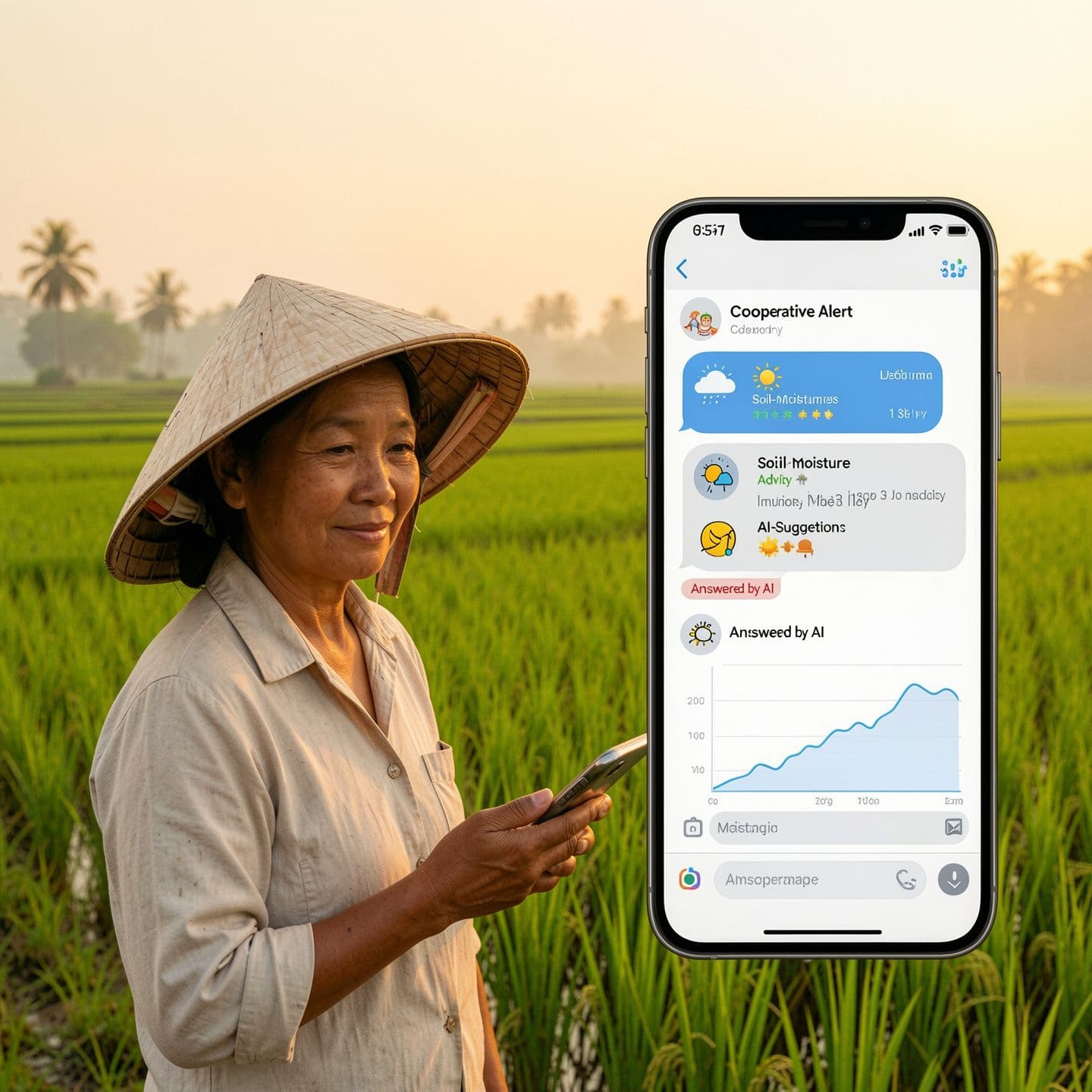
Picture a rice farmer standing at the edge of his paddy field just outside Can Tho, in Vietnam's Mekong Delta, checking her phone before deciding whether to irrigate. She isn't looking at a weather app the way a tourist might check for rain before a trip to the beach. She's looking at a message from her local agricultural cooperative, sent through a chat app she already uses to talk to her neighbours, telling her that soil moisture in his specific plot is trending low and that the next three days will bring the kind of heat that stresses young rice shoots.
She doesn't know that message was generated by a system pulling together satellite imagery, historical yield data and sensor readings from fields like hers across the region. She just knows the cooperative has gotten unusually good at telling her exactly when to water and when to hold off. Her harvests have been more consistent the last two seasons. She puts it down to experience. In part, it's an algorithm quietly doing the forecasting she used to do by instinct and worry.
This is the second layer of AI adoption in Southeast Asia, the one that doesn't show up in flashy launch events or crowded livestreams, but in the ordinary decisions people make every single day without realising a model helped make them.
If food delivery and ride-hailing are the most visible face Of AI in the region, the least visible is what happens after you press "buy” and before the parcel lands on your doorstep.
Walk into a major sorting hub in Malaysia or Indonesia today and you'll find conveyor belts, cameras and scanners working in a rhythm that looks almost too smooth to be human-run because it largely isn't. Parcels are photographed, their labels read, their destinations matched to the fastest combination of trucks, flights and last-mile riders, all before a human worker has had time to glance at the box twice. What used to take a warehouse full of people manually sorting by postcode now happens in the seconds it takes a parcel to travel a metre of conveyor belt.
None of this is marketed to the customer. Nobody opens an app and sees "Al-optimised logistics route" flash across their screen. They just notice that a parcel ordered from three countries away arrived a day earlier than they expected, and think, "delivery has gotten better lately." It has. They just don't know why.
The Philippines has spent two decades building the world's most talked-about customer service industry, and now that same skill communicating clearly, warmly, across accents and time zones has become the training ground for something new. In contact centres across Manila and Cebu, AI systems now sit quietly alongside human agents, listening to calls in real time, surfacing the right policy document before the agent even finishes typing the question, and drafting first responses to emails that a human then reviews and sends. Agents aren't being replaced so much as handed a very fast, very well-read colleague who never needs a coffee break. Call resolution times have dropped. Customers rarely know a machine touched their query before a person did.
The same instinct for language is showing up in education. Filipino students preparing for civil service and licensure exams increasingly rely on adaptive practice apps that quietly track which topics trip them up and reshuffle the next set of questions accordingly, the way a good tutor would, except this tutor is available at lam and never runs out of patience.
Thailand welcomes tens of millions of visitors a year, and increasingly, the first "person" many of them interact with isn't a person at all. Hotel concierge chat systems, tour- booking platforms and even street-level signage translation apps now handle a constant, multilingual conversation between hosts and guests who don't share a word of each other's language. A homestay owner in Chiang Mai can now message a booking enquiry in Thai and have it land, translated and warmly worded, in a guest's inbox in Korean, German or Tagalog within seconds. The guest never sees the seams. They just experience a host who "speaks their language," even when she doesn't, not really, the system does. Small tourism operators who could never have afforded multilingual staff are now competing for bookings on equal footing with big hotel chains, simply because the language barrier that used to separate them from half the world's travellers has quietly dissolved.
By now the pattern should feel familiar, but it's worth spelling out because it keeps showing up in places people don't expect. The subtitle that appeared under a video in your own language within seconds of it being posted by a creator on the other side of the region generated, not typed. The customs paperwork that cleared a shipment overnight instead of sitting in a queue for three days, a system cross-checking documents against thousands of past filings faster than any officer could. The playlist a ride-hailing app builds for your commute, the stock levels a corner store owner restocks before running out, the loan repayment schedules a micro-lender adjusts automatically the month your income dips. None of it announces itself. It just quietly removes friction that used to be someone's problem to solve by hand.
It would be misleading to suggest every corner of the region is moving at the same pace, and that gap is often the most useful thing to understand.
Cross-border trade still runs into friction where systems in one country don't talk to systems in another, meaning a shipment can be beautifully optimised on one side of a border and stuck in a queue on the other. Smaller enterprises in secondary cities outside Jakarta, outside Manila, outside Ho Chi Minh City and often don't yet have access to the same tools their capital-city competitors take for granted, simply because those tools were built and priced with a bigger market in mind first. And a great deal of what makes these systems work, translation models trained on a specific dialect, forecasting models trained on a specific crop, sorting models trained on a specific postal system has to be rebuilt almost from scratch for each new market. What works beautifully in Jakarta doesn't automatically work in Phnom Penh.
These are engineering and investment problems more than anything else, and they're the kind that close with time, capital and local partnership, not the kind that require a grand debate to resolve.
If you have read this far looking for the moment AI arrives in Southeast Asia, you have already missed it. Its arrival was observed as the parcel that turned up a day early and a homestay booking enquiry that answered itself in a language the host does not speak. Which means the useful question is no longer whether to adopt, but what to do now that everyone around you quietly has. Three things follow from that.
The invisibility is the strategy, not a marketing failure. Almost nothing described above was sold as an AI product. It was sold as faster sorting, better forecasting, shorter call times. The organisations getting real value went looking for their slowest manual handoff, not their most impressive use case. If you are trying to work out where to begin, the honest answer is usually the least glamorous process you own: the one where someone re-keys data, chases an approval, or waits three days on a translation. Local specificity is a moat, not just a cost. The most inconvenient fact in this piece is that a model trained for Jakarta will not work in Phnom Penh. It is also the most commercially interesting one, because it means the advantage here does not automatically flow to whoever holds the largest global model. It flows to whoever holds the local particulars: the crop, the dialect, the postal system, the regulatory quirk. Businesses already operating in these markets are often sitting on that asset without having priced it.
The floor is rising faster than the ceiling. A homestay owner in Chiang Mai now competes with international hotel chains on multilingual service. So far, AI in ASEAN has behaved more like a leveller than a concentrator, and that cuts both ways. Capabilities that were a genuine differentiator two years ago are becoming table stakes. The cost of adopting has fallen below the cost of being the last one who has not.
It is worth reading the gaps in the same spirit. Cross-border systems that do not talk to each other, secondary cities priced out of capital-city tooling, models that must be rebuilt market by market: these are not caveats attached to the story. They are a list of markets that do not yet have an owner, and they are the parts of the region where the next decade of value will be built or lost.
The takeaway is not that AI is coming to Southeast Asia. It is that AI is already load-bearing here, and that most organisations in the region are further along than they realise and less differentiated than they would like to be.
By the time the rice farmer checks her phone again the next morning, the irrigation schedule has already adjusted itself for the day's forecast, the cooperative's group chat has a new note about which plots to prioritise, and somewhere in a data centre hundreds of kilometres away, a model has updated its picture of soil conditions across thousands of fields just like his. She still calls it "the co-op's system." She has no reason to call it anything else. But the quiet truth sitting underneath rice paddies, sorting hubs, contact centres and tour bookings across Southeast Asia is the same one we keep encountering across every market it works in: the region isn't waiting for an AI revolution to arrive. It has already arrived, dressed up as slightly better logistics, slightly smarter forecasts and slightly smoother conversations and it's already woven into more of daily life here than almost anywhere else in the world.