Timor-Leste operates one of the simplest and lowest-headline tax regimes in Southeast Asia, a deliberate feature designed to attract both domestic and foreign investment. Taxes are governed by the Taxes and Duties Act 2008 and administered by the Timor-Leste Revenue Service.
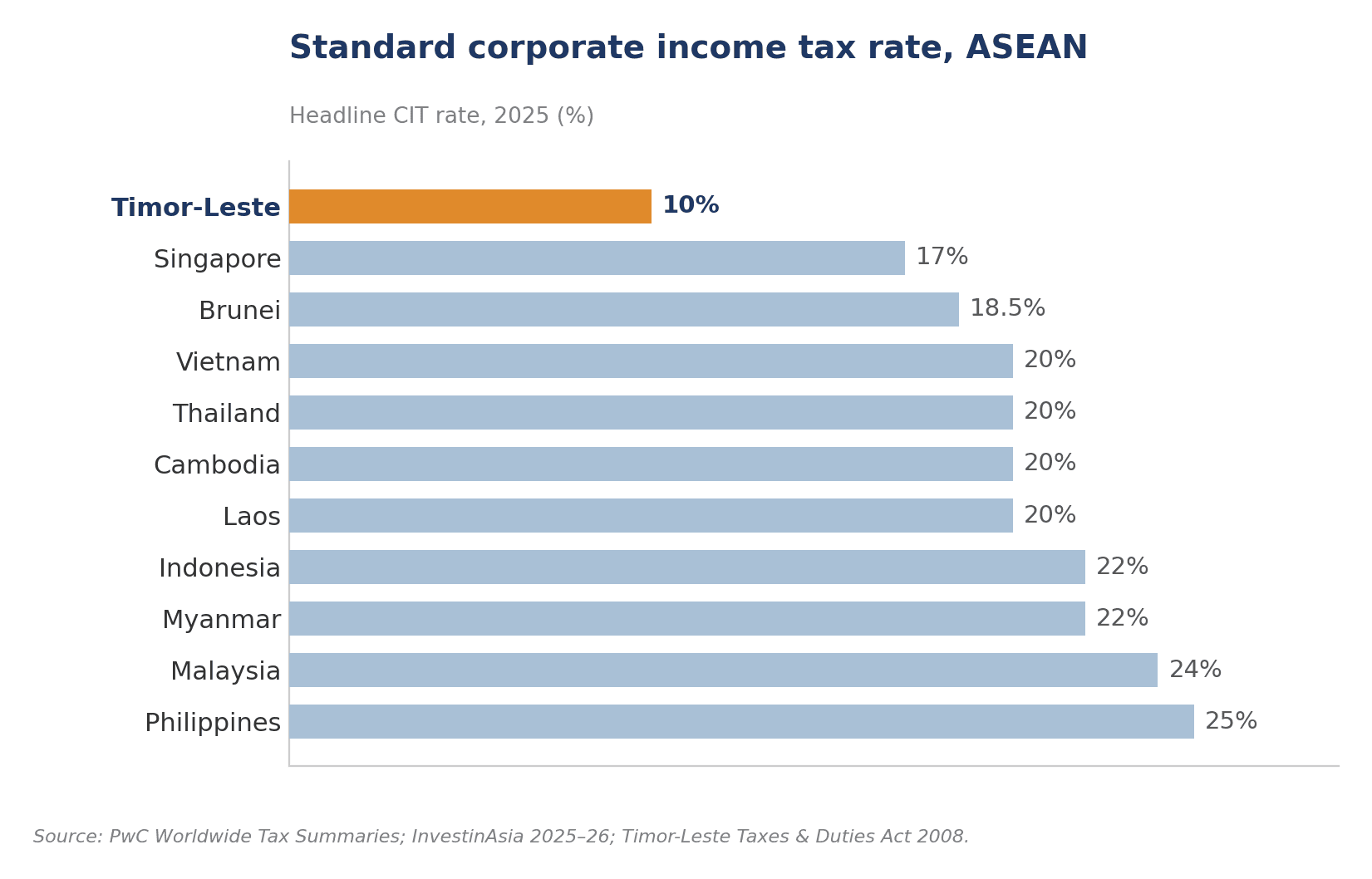
Corporate Income Tax (CIT): The standard rate is a flat 10%, well below the rates prevailing across most ASEAN economies and among the lowest in the region. Companies resident in Timor-Leste are taxed on worldwide income; non-residents are generally taxed only on Timor-Leste-source income. Higher rates apply only to the petroleum sector, where oil and gas contractors are taxed at 30% (sub-contractors generally at 6%) and a Supplemental Petroleum Tax may also apply. Tax losses may be carried forward indefinitely, subject to continuity-of-ownership tests, and dividends are tax-exempt in the hands of resident recipients.
Wage Income Tax (WIT): Employment income for residents is taxed progressively: 0% on the first US$500 of monthly wages and 10% on the excess. Non-residents are taxed at a flat 10% with no threshold. Employers withhold and remit WIT monthly.
Other taxes: Timor-Leste levies no value-added tax (VAT) and no stamp duty. A modest sales tax of 2.5% applies to imported goods, while goods and services sold domestically are taxed at 0%, a notable advantage for businesses serving the local market. A 5% services tax applies to hotel, restaurant, bar and telecommunications turnover above US$500 per month, and import duty is generally 2.5%. Withholding tax on various payments ranges from 2% to 10%.
Together, these low, flat and predictable rates make Timor-Leste a genuinely competitive tax jurisdiction within ASEAN.