Foreign direct investment into Timor-Leste remains modest and cyclical, reflecting the economy's early stage of development, net inflows were in the region of US$0.2 billion in 2024, and the country has yet to attract FDI at the scale of its larger ASEAN neighbours. This is, however, a low base from which membership of ASEAN and the WTO (which Timor-Leste joined in February 2024) is expected to lift investor confidence, offering a credible signal of stability to capital that has historically been deterred by perceptions of risk.
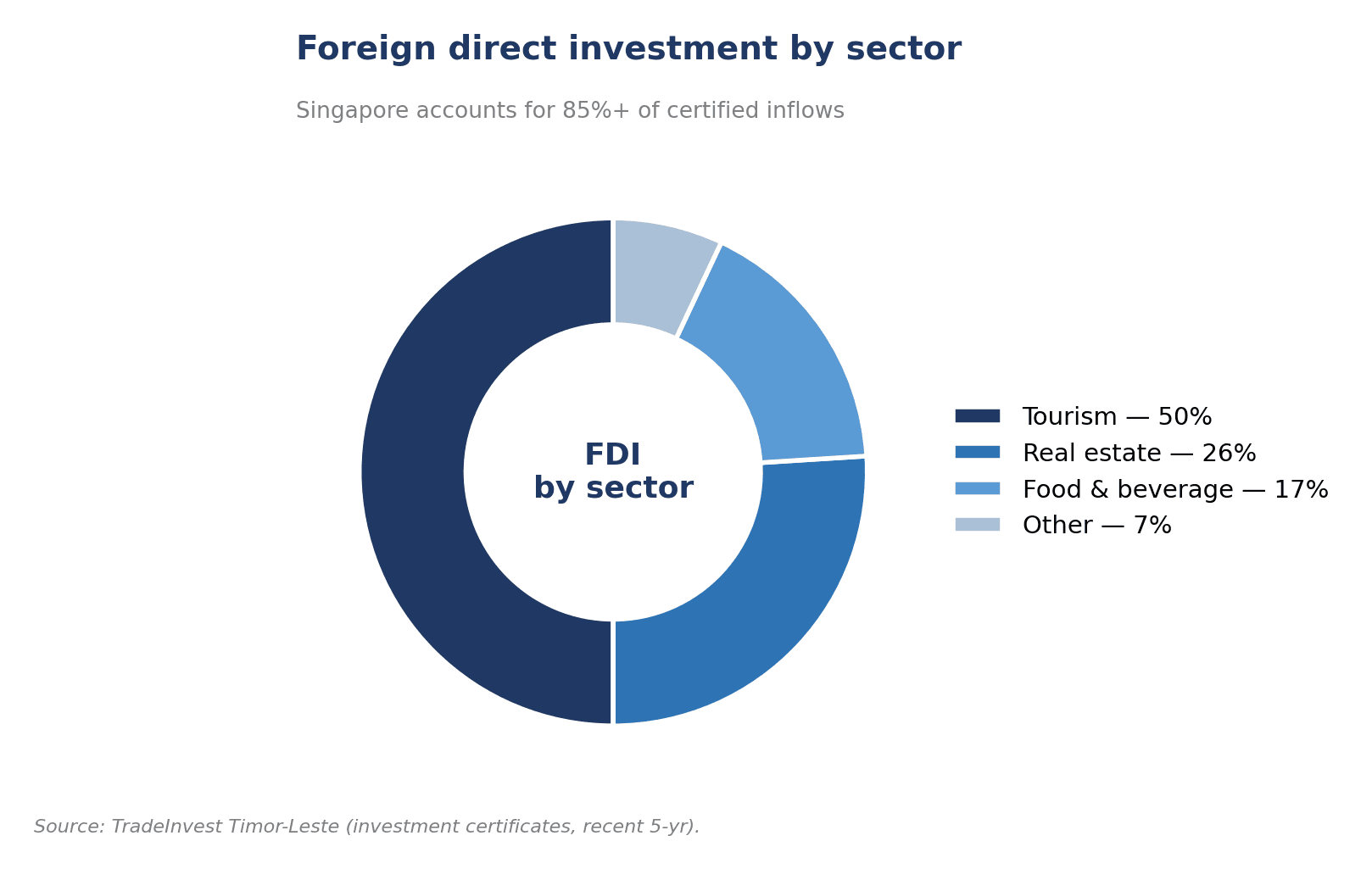
Based on investment certificates issued by TradeInvest Timor-Leste, the country's investment and export promotion agency, Singapore has been by far the largest single source of foreign investment in recent years. Inflows have concentrated in a handful of sectors, tourism, which has attracted close to half of all flows, followed by real estate and food and beverage production, which together account for the large majority of certified investment. The government is actively working to broaden this base into agriculture, fisheries, manufacturing and energy.
Foreign investors are guaranteed equal treatment before the law under the Private Investment Law (2011), supported by the Companies Code and the Commercial Registration Code. TradeInvest acts as the single point of contact, aiming to issue investment decisions within 30 days; application fees are US$500 for national and US$2,000 for international investors. Larger projects, those above US$20 million or requiring significant state land, are handled through Special Investment Agreements approved at Council of Ministers level, and a published “negative list” sets out the limited sectors where foreign participation is restricted.
Timor-Leste's flagship zone is ZEESM (the Special Zone for Social Market Economy) in the Oecusse exclave, established under Law No. 3/2014, with a complementary initiative on Atauro Island; the government is exploring an expanded Special Economic Development Zone in Oecusse to accelerate investment. Landmark projects such as the US$490 million Tibar Bay Port— the country's first public-private partnership, operational since 2022 — signal the scale of opportunity in infrastructure.