A vivid look at how AI is quietly transforming everyday life across Southeast Asia not through grand tech initiatives, but through the apps and platforms millions of people already use.
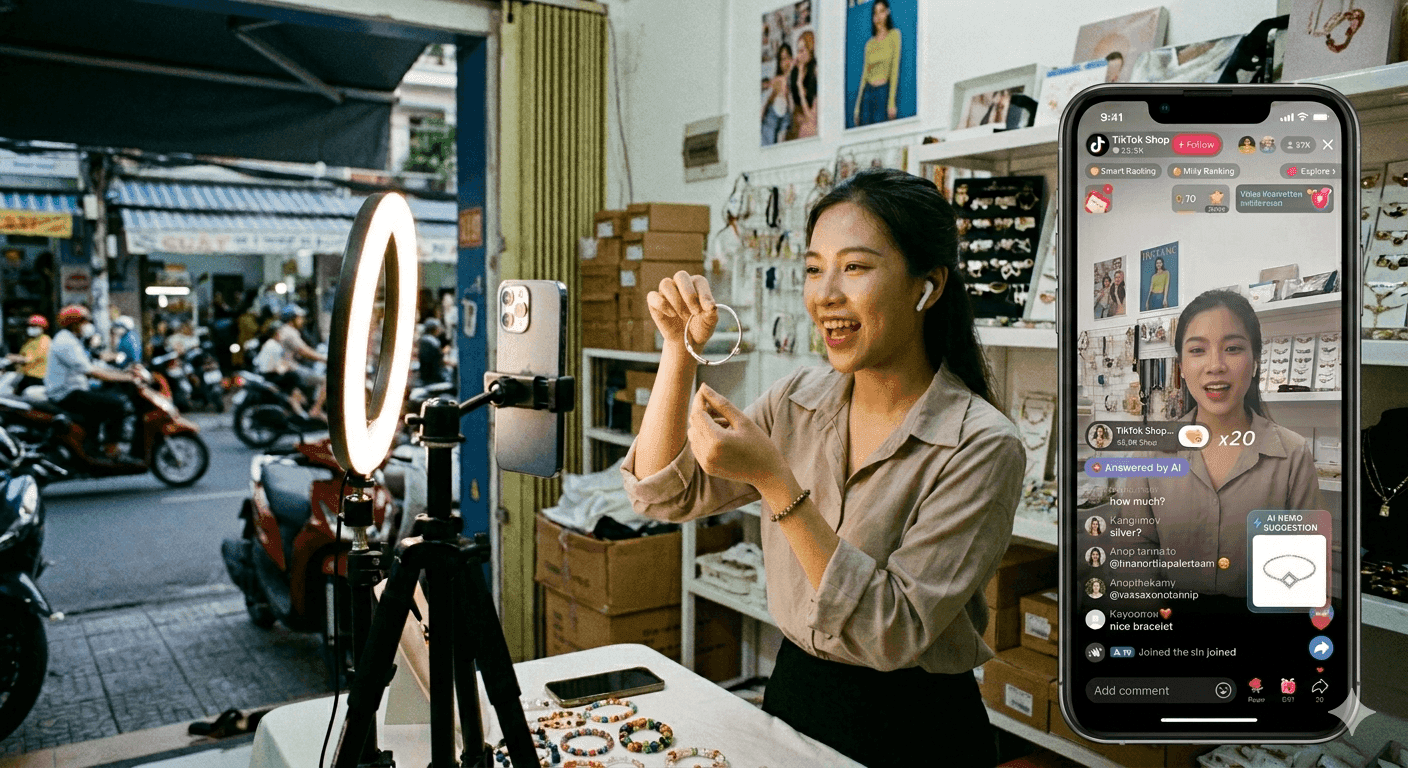
Picture a young woman selling fashion accessories through a livestream on her phone in Ho Chi Minh City. She runs her shop out of a single room and has no IT team, no data scientist, no business degree. What she does have is her phone, a ring light and an AI system quietly working in the background that she didn't consciously install, it came built into the platform she sells on.
As she holds up a bracelet to the camera, the system is already tracking which products viewers pause on, suggesting in her earpiece which item to demo next, auto generating replies to the flood of comments asking "how much?" and "does it come in silver?" She doesn't think of it as artificial intelligence. She thinks of it as her shop running a little more smoothly than it used to.
This is Southeast Asia in 2026. And it is moving faster than most people outside the region realise.
What's happening in her room in Ho Chi Minh City is a microcosm of a much larger shift. Across Southeast Asia, AI isn't arriving as a grand corporate initiative, it's sneaking in through the apps people already use. It's in the delivery platform that tells the rider the most efficient route before he even puts on his helmet. It's in the customer service chat that answers your refund question at 2am. It's in the credit check that lets a first-time borrower in Jakarta get a small business loan in twenty minutes, without ever walking into a bank.
The region has a secret weapon that most global tech conversations underestimate: its people. Southeast Asia is young, mobile-first and deeply online. Over 70% of people across the region use smartphones, and a significant portion of them have never used a desktop computer at all. The internet, for them, has always lived in their pocket. That means AI tools that work on mobile tools like what she uses and have an enormous, ready audience.
If the aforementioned example represents where AI is going in Southeast Asia, Singapore represents where it has already arrived.
Singapore's AI infrastructure is world class. Its government has been one of the most proactive in the region in building national AI policy. Walk into almost any large Singaporean company and you'll find teams actively using AI to handle everything from customer queries to financial forecasting.
But here's where it gets interesting. Singapore's challenge isn't adoption anymore. It's staying ahead when every neighbour is catching up fast. The countries that were once watching from a distance are now sprinting.
Indonesia is the country that surprises people most. With a population of over 270 million people and a geographic spread across thousands of islands, you might expect AI to be a luxury for the few. Instead, necessity has driven innovation. In Indonesia, AI is helping small businesses that can't afford large teams to function as if they have them. A batik seller can manage customer enquiries across three platforms simultaneously, not because she hired assistants but because AI handles the routine responses while she focuses on the actual craft.
What makes Indonesia's AI story particularly human is the effort to make the technology speak local. Researchers have been building AI tools that understand hundreds of regional languages, so the benefits don't stay trapped in Jakarta.
Vietnam's story is similar but scaled up. AI has woven itself into ecommerce in ways that feel completely normal to young Vietnamese users. A gaming platform called Lita Global used AI to help gamers respond to potential clients more effectively and saw booking rates climb noticeably as a result. These aren't dramatic, headline grabbing changes. They're small improvements, multiplied across millions of people's daily lives. That's what transformation actually looks like from the inside.
What AI Looks Like in Your Daily Life
Let's make this concrete, because "AI adoption" can sound very abstract until you realise you've already been living it.
Think about the last time you ordered food on Grab or Gojek. The price you were shown wasn't random, an AI estimated demand in your area at that moment and adjusted accordingly. The restaurant that appeared at the top of your list wasn't there by accident, it was placed there because the system predicted, based on your history and the habits of people similar to you, that you were most likely to order from it. The time estimate wasn't a guess, it was calculated in real time using traffic data, the number of active riders nearby and the kitchen's current order queue.
None of this required a tech team on your end. You just ordered dinner.
That's the most important thing to understand about how AI is spreading through Southeast Asia. It isn't arriving in the form of robots or research labs. It's arriving embedded in the services people already rely on food delivery, ride-hailing, online shopping, mobile banking. For most people, AI is invisible. It just makes things work a little better than they did before.
The Gaps That Still Exist
It would be dishonest to describe this as a smooth, uniform wave. It isn't.
The benefits of AI are unevenly distributed. In major cities like Ho Chi Minh City, Jakarta, Kuala Lumpur, Manila, the tools are everywhere. In rural areas, connectivity itself is still a barrier. A farmer in a remote part of Myanmar or Cambodia may have a smartphone but not reliable enough internet to use the same tools that are transforming urban businesses.
There's also a deeper question about who controls the intelligence. The AI that helps her sell her bracelets is also the AI that decides how visible she is on the platform. The same system that boosts her sales today could deprioritise her tomorrow. These aren't hypothetical concerns, they're the kind of questions that matter as AI becomes more deeply embedded in people's livelihoods.
No government in the region has yet issued binding rules about how AI should behave partly out of a genuine desire not to slow down the growth that AI is enabling, but partly because the questions are genuinely hard to answer.
By the end of her livestream, she has sold forty three items. The AI has already restocked her virtual inventory list, flagged the three products that performed best and drafted a promotional post for tomorrow. She closes her phone and makes dinner.
She didn't go to business school. She doesn't know what machine learning means. But she is, in every practical sense, running a data-driven business and doing it better than most companies were able to manage a decade ago.
That is the real story of AI in Southeast Asia. Not the billion-dollar investment figures. Not the government policy papers. It's the rider who just got a better route suggestion, the first-time borrower who just got approved and the millions of people across the region for whom the technology is already working, even if they've never once called it AI.
The tools are here. The people are ready. The only question is whether the infrastructure, the policy and the investment keep up with the energy that's already there.